Showing posts with label triple ipa. Show all posts

Wednesday, 4 February 2015

An Abstrakt Concept

"INTRODUCING THE WORLD'S FIRST CONCEPT BEER BRAND" bellowed the press release announcing the launch of Brewdog's Abstrakt range of beers back at the tail-end of 2009. Promising to be 'MORE ART THAN BEER', the 17 releases on the label to date have been beautifully packaged in 375ml champagne bottles with jet-black corks and cages. The styles have varied from quads to imperial stouts to barley wines, but the ABVs have been high and the adjuncts extensive.


When this tweet went out last month, it attracted the response you would expect. A 'Cookies and Cream Imperial Stout' might be in keeping with the syrupy-sweet, adjunct-heavy beers in the range over the past few years, but as every attention-hungry craft brewery starts boosting their gravities and shovelling crazy flavours and Flumps into their conditioning tanks, the Abstrakt range has started to look less like an arty concept and more like... just another set of big beers.

In addition, up to this point almost every Abstrakt beer has encouraged the hoarder. Huge ABV monsters, released Across the UK, thousands of dusty black demi-bouteilles clog up cupboards as beer enthusiasts avoid opening their numbered collectibles. Beer is there to be drunk though, and up to this point, Abstrakt has served to discourage the consumption of the beers. I think it would be fun to flip that on its head and produce an Absrakt that needs to be consumed urgently.

So - here's my idea for a future Abstrakt. For convenience's sake, let's call it Abstrakt 20.

Abstrakt 20 would be Brewdog's first ever DOGO release - an appropriately canine acronynm meaning Draught-Only-Growler-Only. Instead of paying 9.99 for a low-profile corked-and-caged 375ml champagne bottle from their online shop, their Bottledog bottle shop or their bars, Abstrakt 20 would be a numbered 1 litre swing-top. I could imagine it being covered in a unique piece of artwork from one of their regular artists, such as Craig Fisher or Johanna Basford... or being almost entirely empty, save for a small logo and a bottle number. Whatever works for James Watt and company. What is paramount is that it is empty.

A 1 litre flip-top bottle, yesterday.
The beer destined for the Abstrakt 20 bottles should be time-limited, designed to be drunk at its best. In the spirit of Magic Rock's Un-Human Cannonball or - topically - Russian River's Pliny the Younger, it should be as big a double or triple IPA as can be wrung out of the Ellon brewhouse, with a final gravity coaxed as low as possible and dry-hopped to the point that the centrifuge tries to tender its resignation. Brewdog, for all their air-freighted IPA imports and Love Hops... neon signs, have never attempted to brew the ultimate big IPA, so this would be their chance.

On the day that the beer can be released, the Abstrakt 20 bottle can be taken to one of their bars or shops and filled, at no charge, with the beer. If the owner of the bottle wants to take it home, then so be it; if they want to grab four glasses and split it with their table in the bar, no problem. However, no bottle, no beer - without the Abstrakt 20 bottle, one cannot expect a pour of the beer that goes inside.* If you want to drink the beer, you would either need to get hold of your own bottle, or find somebody who has one and is willing to share. Abstrakt 20 would be either the ultimate social beer - destined to be shared - or the ultimate antisocial beer - open it alone, and you would need to finish it alone to enjoy it at its peak. Either way, it would be more art than beer.

On the front of the bottle are three boxes. When the bottle is filled, the server fills one of the boxes in with an indelible paint marker - they can tick it, draw a smiley face, write their initials, whatever they are in the mood for. Once the owner has enjoyed their three fills, and all boxes have been completed, it cannot be refilled again - and thus their Abstrakt 20 is complete. A unique piece of art, comprising the bottle artwork (or lack thereof) and the three contributions from the people who filled it.

Abstrakt 20. More art than beer. Coming soon?

(* - In reality, I think if a keg had been on for a week, I think it could be opened up to be poured like any other beer rather than simply ditched in the name of 'art'... Brewdog are a business, after all.)

Friday, 28 December 2012

Brewing the Megabeer Part 1

The 'megabeer' that I described in the last blog has been brewed and is fermenting away - I need to work on a better name for it than 'megabeer', but that can wait until later. As usual, there were a few hitches along the way that blew me off course on the day, so much so that I didn't actually pitch the yeast until nearly 5.30am on Christmas Eve.

The recipe was almost as described in the last blog - I cut the amber back a bit to less than 5% to make sure the final beer wouldn't be too dark:

8kg Pale Malt (Crisp)
400g Amber Malt
Mash at 64/65C for 90 mins with 24l Campden-treated water (I don't do water chemistry yet!)
This was quite a thick mash, but my mash tun couldn't take any more water.

Two very different amber malts
The first problem was that when we started to run the wort out of the tun, it was much darker than anticipated - much, much darker than expected, like strong tea, and not really what I was looking for, given that it was only going to get darker over the course of a two-hour boil. We'd put the wrong amber malt into the tun - instead of the EBC 48 bag, we picked the EBC 100 bag, hence the coffee-scented dark brown wort. (Incidentally, the EBC 100 Fawcett malt is what Dogfish Head use in their 60/90/120 Minute IPAs by many accounts, but although the beer is inspired in part by other people's clones of 120, I'm not trying to make an outright clone of that beer).

So, we made a snap decision to drain the tun without sparging, boil up anything we ran off along with some Fuggles hops that had been hanging around for ages, pitch the backup sachet of dried yeast I keep in case of emergencies, and start again. Using a Scotch Ale as a basic direction, we collected just over 20 litres of deep brown wort, gave it a short 45-minute boil with 50g Fuggles, then ran it off, took a gravity of 1.080 and pitched rehydrated Mauribrew 514 yeast. For an old sachet of dried yeast, it's done a good job - after 3 days, it was down to 1.028, and it's still going.

Hop soup - with the pellers now in sludgy suspension
While all that was boiling up, we reset the HLT and started mashing a second batch of malt. Mashing low for a highly fermentable wort, we collected as much as we could get into the boiler - 23.5 litres - knowing that we would lose a lot to the boil... and to the hops. I mixed together 250g of high-AA hop pellets (130g Amarillo, 60g Columbus, 60g Galaxy) and 75g whole-leaf Simcoe, and divided them into five equal portions, to be added at 120, 90, 60, 30 and 0 minutes. As expected, I lost a hell of a lot between the start of the boil and the FV - a shade over 15 litres. Runoff took a long, long, long time - about 2 hours - as the pellets broke down into a thick sludge that covered the hop filter and, together with the Simcoe flowers, slowed the runoff to little more than a drip at times. I need to work on a better hop filter for my boiler. I could have thrown in some more late hops, but I'm going to save them for a bigger dry hop.

300g Dextrose Monohydrate
Gravity was measured at 1.108, which was a few points up on where I thought I'd be. I allowed the WLP007 5 litre starter to settle down to a big cake at the bottom, siphoned off the top 4.5 litres of it, then swirled the cake into suspension and pitched it. After that, I made a 3-litre starter for the WLP099 high-gravity yeast, and left it to grow for three days. I left the FV in the utility room where the temperature stays at a good, constant 19C (I'll use a heatpad if I need to raise the temperature later in the ferment), and it was fermenting wildly within hours.


On the 26th, 60 hours after pitching, I took the first gravity reading at 1.030 - incredible work from the WLP007 to chew through that much so quickly - and pitched the slurry from the WLP099 starter, along with 400g dextrose monohydrate. I've measured the remaining 3.6kg of the dextrose into 300g and 150g freezer bags, and the plan is to add all of this to the FV over the next few days to give me an adjusted OG of somewhere around the 1.200 mark.


The routine goes like this - I keep a bucket of sanitiser next to the FV containing two jugs, a silicone whisk, my hydrometer and my baster. Twice a day, I take the two jugs out, drain them both back into the bucket, put the whisk and the drained baster in one jug so that they're handy. I then take a sample for the hydrometer and record the gravity, then pour this into the other jug and continue to draw beer from the FV until I have about half a litre in the jug. I add in 300g of dextrose from one of the freezer bags, whisk it into the beer until foamy and in solution, then pour it into the FV and seal it up again. I then clean all the equipment and put it back into the sanitiser.
Whisking in the dextrose


I'm hoping to keep the OG somewhere around or just under the 1.030 mark - if I take a gravity reading and the yeast hasn't chewed up all 300g of the dextrose from the previous addition, I'll switch to adding the 150g bags.

So far, it seems to be turning out very nicely! I reckon the ABV is up around the 13% mark by now, and the aroma from the FV is wonderful. My main concern is that during one of the dextrose additions, I'll introduce an infection of some kind, hence the sanitising routine each time I open it up. It's been hard work having to nurture it for as long as I have so far, but I hope it'll be worth it. I'll be back with an update once I've finished the primary fermentation and the beer is ready to enjoy a nice, mellowing rest in secondary for a few weeks.

Thursday, 16 February 2012

SF Beer Week: Wednesday


If big bourbon barrels defined our Tuesday drinking out here, today was all about huge IPAs. One of the features of the first week of February in California is the release of the almost mythical Pliny the Younger, Russian River's triple IPA that features regularly in may beer aficianodos’ best beer in the world lists. Their double IPA, Pliny the Elder, is available on tap almost year round in California, but Younger, which has an even bigger hop schedule, is only available for the first couple of weeks of February. If you follow any American beer bloggers on Twitter, you’ve no doubt seen some kind of acerbic comment about the frenzy that accompanies the release of Younger. e.g. 'what is this 'Younger' and why do we have to queue for him at 7am!?!?'. And so forth.

When we sorted our trip to California, seeking out a taste of the Younger was one of the first things on the agenda. Now that our jet lag had finally worn off, it was out best opportunity. We’d been tipped off that the Toronado would be putting a fresh keg of Younger on every day until the end of Beer Week, but as they open at 11.30am every day, we didn’t want to waste any time, so headed off down Haight St. Drinking a huge IPA before lunchtime might seem insane, but if the alternative was missing out on Younger altogether, then we were game for some early-bird boozing.

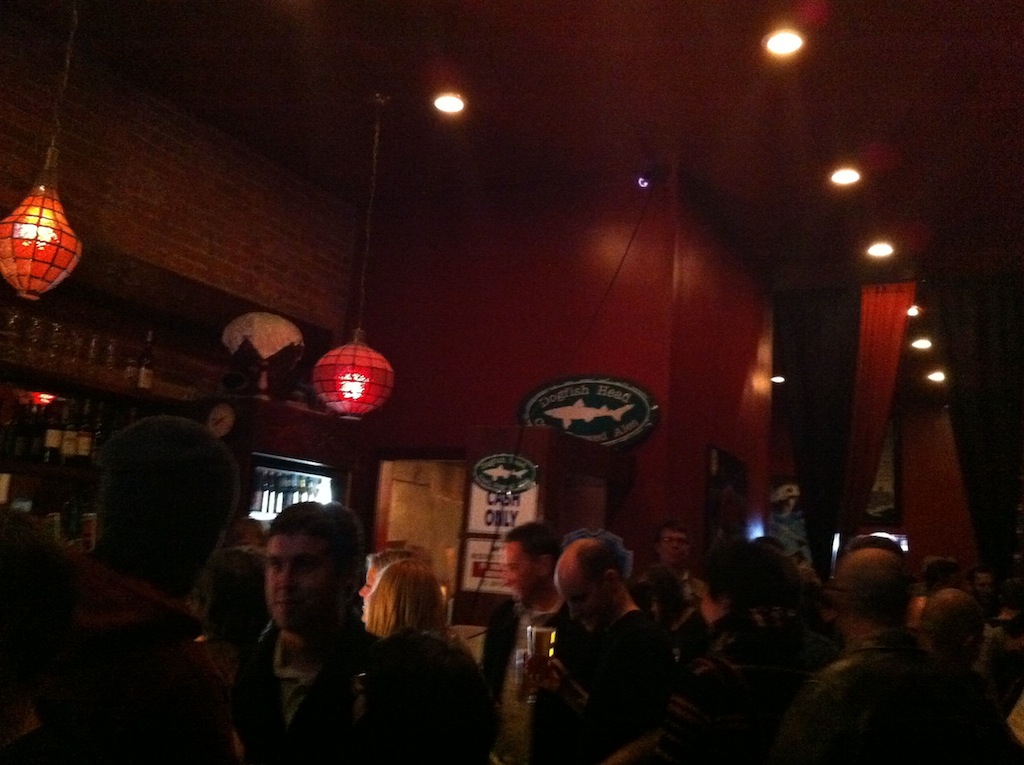
When we finally found the Toronado, it was a fantastic sight. A stable door at the entrance, Chimay signs outside, neon signs and paraphernalia for all the great breweries of the world hanging inside, and more than 20 beer lines to deliver an incredible range of beer. I wish I’d taken more photos of the place – when you walk into somewhere like Brewdog Camden and see what they are trying to achieve in their house bar, this must be the sort of place they have in mind. Jukebox in the corner, every seat filled by 12.30 with people drinking double IPAs or Belgian-style quadrupels or imperial stouts… Perfect.

The scoreboard-style list of beers on draught didn’t seem to be up to date, and on approaching the bar they told me to refer to that day’s printed beer menu, and to order by number. Disappointingly, there was no Younger, so I went for a 'number 2' – Pliny the Elder, the little brother of younger, but still an 8% double IPA. While I was waiting for it to be poured, the guy at the bar next to me said ‘You do know they have Younger on, the bigger version of Elder? They just don’t put it on the menu.’ – and so I asked for a Younger to go with its big brother. Clearly, ordering Younger requires a bit of inside knowledge, a secret password, or something similar - but anyway, I was finally in and ready to try some PTY.

(l-r - Russian River Pliny the Younger, Russian River Pliny the Elder)

When it came – in a miserly 6oz pour – Younger was lighter than I thought it would be, and lighter than Elder in colour. Check the photo to see what I mean. I’m glad I’d ended up ordering the Elder first, as tasting them both side by side showed up how much difference there was between the two. Elder was a classic California double IPA – big on the floral aroma, thick malt backbone, piney bitterness to finish. But Younger was something different – where the hops took it beyond what you’d expect from a beer. Conventionally, you’d think that the more you hop a beer, the more bitter it is and that has to be balanced by more malt. However, at no point while drinking the Younger do you feel that the hops are leading the beer. It is, by all accounts, an insanely hopped beer, with three hop schedules, according to Russian River’s website, but because the balance is so good, you taste an intensity and subtlety of the hops that I’ve never tasted before. All kinds of citrus peel and tropical fruits come to the fore but never dominate. I’m not a good enough writer about beer to really describe it, but I could have drunk it all day. And when dealing with a ‘triple IPA’ with an ABV of 11%, that’s a very dangerous thing to say.

Once the sun had gone down, we headed over to the Amsterdam CafĂ© in the Tenderloin (despite instruction from the porter at our hotel never to venture into that area on safety grounds… sorry Johnny). Their line-up of SFBW events is superb – if it hadn’t been for the intervention of our friend Mel, we would almost certainly have given their Mikkeller night a look on Tuesday. Wednesday belonged to Dogfish Head though, with ten different brews on draft and another 8 in bottle, including a few rareties. We had to wait for 10 minutes to get into Amsterdam as the bar was absolutely rammed, but queuing up outside was a small price to pay for what we found once we got in.

(The bar at the Amsterdam Cafe - we'll definitely be back here before we fly home)

As I said in my introduction to the blog, DFH are largely responsible for my conversion to America’s fantastic beers, but because they are so hard to find in the UK, I haven’t touched a Dogfish beer since New Year’s Eve 2010. Walked into a bar where they’re casually tapping 120 Minute IPA is like striking the motherlode, and that’s exactly what they were doing at Amsterdam. I started off with a glass of that, and it was everything I hoped it would be – huge sweetness and bitterness, with a distinct orange marmalade flavour mixed with that classic Scottish liqueur Drambuie. It was brilliant.

To provide a bit of a contrast, we had 16oz of their Chicory Stout, and while DFH are known for their experimental brews, their more conventional beers can still be a knockout. This was full of rich, dark flavour, with a hint of chicory bitterness – although G complained that it was a bit lacking in depth (something I’m going to put down to a couple of days of drinking massive barrel-aged stouts).

Something DFH have been trying over the past few years is to recreate past beers drunk by fallen historical empires, which brings us to Theobroma – recreated after analysing pottery found in Honduras that may once had held a cocoa-based beverage. Dogfish used this analysis to create this beer, bewed with chillies and cacao. I was expecting a dark beer, so when I had a glass of pale ale handed to me, I had to check that it wax definitely what I’d ordered! This reminded me a little of De Molen’s hugely disappointing Bed and Breakfast coffee beer – plenty of bell pepper in the palate (the Bed and Breakfast is dominated by this, in a bad way), before giving way to some coffee and then a mouth-filling chocolate character. There was no chilli flavour, which was disappointing considering that that was what had been billed as the main influence on the beer apart from cacao, but we still enjoyed it nonetheless. It was refereshing and never overwhelming, and I’d love to try this again.

(Dogfish Head's Theobroma aztec cacao beer - not the big dark beer you expect!)

To finish the night, we decided to try Faster, Bigger, Better Bolder, DFH’s collaboration with the Bruery on a Japanese beer, in aid of the victims of the 2011 earthquake that devastated the country. The promise of two kinds of sesame seeds, ginger, cayenne and a sake yeast was clearly a draw for the crowd at Amsterdam, as unfortunately it was sold out when I ordered it. A kind gent next to me at the bar let me have a taste of his bottle, and it was exceptional – slightly savoury, dry, quite thin, a little spicy and undeniably Japanese. In search of something else to drink, we opted for the honey-laced imperial stout Bitches’ Brew, created in honour of the Miles Davis record. Roasty and rich, it was just what we needed to finish our session.

(Dogfish pay tribute to Miles Davis with Bithces Brew - big, dark, roasty and tasty)

The day belonged to the big IPAs though, and Younger and 120 Minute IPA are examples of the kind of niche, off-kilter, massive-hop beers that I love to drink. And long may they continue to be brewed (even if I have to travel thousands of miles to drink them).

PS Brewdog have pre-announced a 16.5% triple IPA - Anarchist Alchemist - with a massive hop bill and an extensive dry-hop schedule, which they should be releasing during the spring. So perhaps I won't have to come all the way to the US for my big hop fix in future...